

General
Why Is DuckDB So Fast?
When working with large-scale data, you have to deal with many performance issues. Those who use pandas have experienced that it slows down once the dataset exceeds a few million rows. SQLite was not designed for analytics, and data warehouses are too complex for trial-and-error processes because they require architectural design. At this point, DuckDB, as an in-process database, provides both flexibility and speed without requiring you to set up a cluster.
So what makes DuckDB so fast?
1. Column-Based Storage
Unlike traditional databases, DuckDB stores data in a column-based format. Traditional databases prefer row-based storage due to OLTP requirements.
Row-based storage is more suitable when data is frequently updated or when new rows are frequently inserted.
Column-based storage is much faster for analytical workloads and more static datasets.
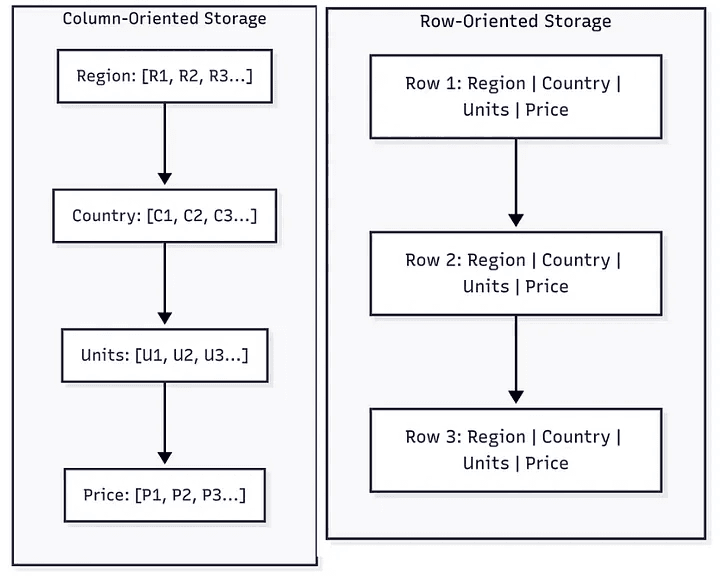
Column Oriented vs Row Oriented
DuckDB reads only the unit_price and region columns. Especially in data structures with many columns, this provides a significant performance gain.
2. Vectorized Execution Engine
DuckDB processes data in vectors (chunks where thousands of values are stored together). Instead of processing row by row, chunks are processed collectively, and this processing is done in parallel. This enables full utilization of CPU power.
At this point, especially for workloads running as jobs in the cloud or triggered on Docker/Kubernetes clusters, it becomes possible to start them with the required compute power and apply different sizing for different workloads. In cloud environments, scalable workloads also enable scalable costs.
Instead of:
These techniques - together with cache utilization, branch prediction algorithms, and vectorized execution - enable the CPU to operate at full capacity.
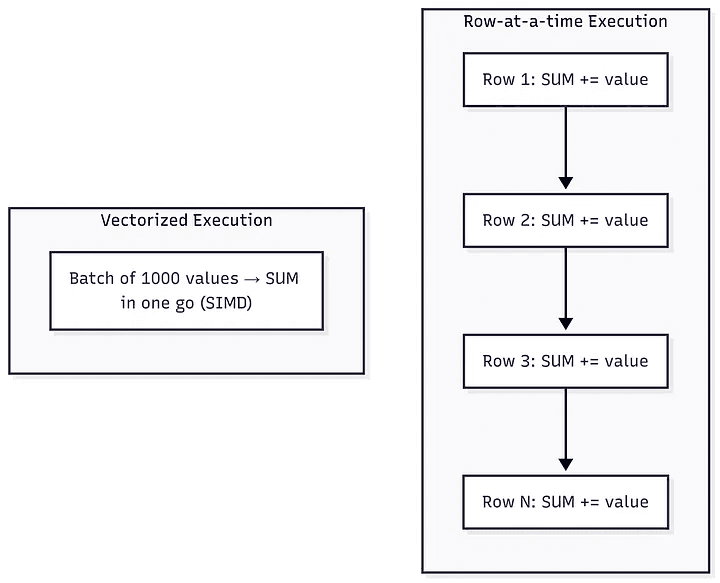
3. Memory Management
DuckDB does not attempt to load all data into RAM like pandas. It uses a technique called the out-of-core execution model and loads only the necessary parts of the data into memory.
Consider the following query:
Even if the dataset is larger than RAM, DuckDB processes the data by dividing it into chunks.

4. Compatibility with Modern Formats
DuckDB works fully compatible with the following data formats:
CSV
Parquet
Arrow
With DuckDB’s zero-copy principle, queries run directly on these files without importing them into the system (e.g., pandas). Together with the chunk-based processing and memory management principles mentioned above, this provides high efficiency.
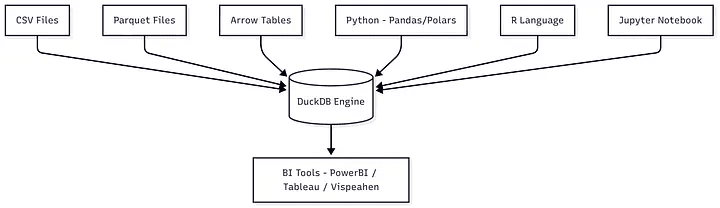
Without setting up a data warehouse or building ETL pipelines, you can run SQL directly and see your analysis instantly.
5. Parallel Execution
DuckDB utilizes all available CPU cores to create parallelism in your queries. For example, when a GROUP BY statement runs over 100 million rows, the rows are divided into different threads and query times decrease dramatically.
When this concept is combined with vectorization, DuckDB becomes a system that uses its available resources in the most efficient way.
It can be considered one of the leading cost-effective and efficient solutions for pipelines running as jobs in cloud environments.
Conclusion
DuckDB is a very well-designed query engine. For those who are frustrated with the bottlenecks of systems like pandas or tired of the difficulty of maintaining distributed systems, it is a perfectly suited solution.